
Slakh · Add
SSIM 0.98
“Music piece. Instruct: Add bass.”
01 Input mix
02 Reference target
03 AURA edit
Research / AURA
A unified multimodal framework for conversational music editing.
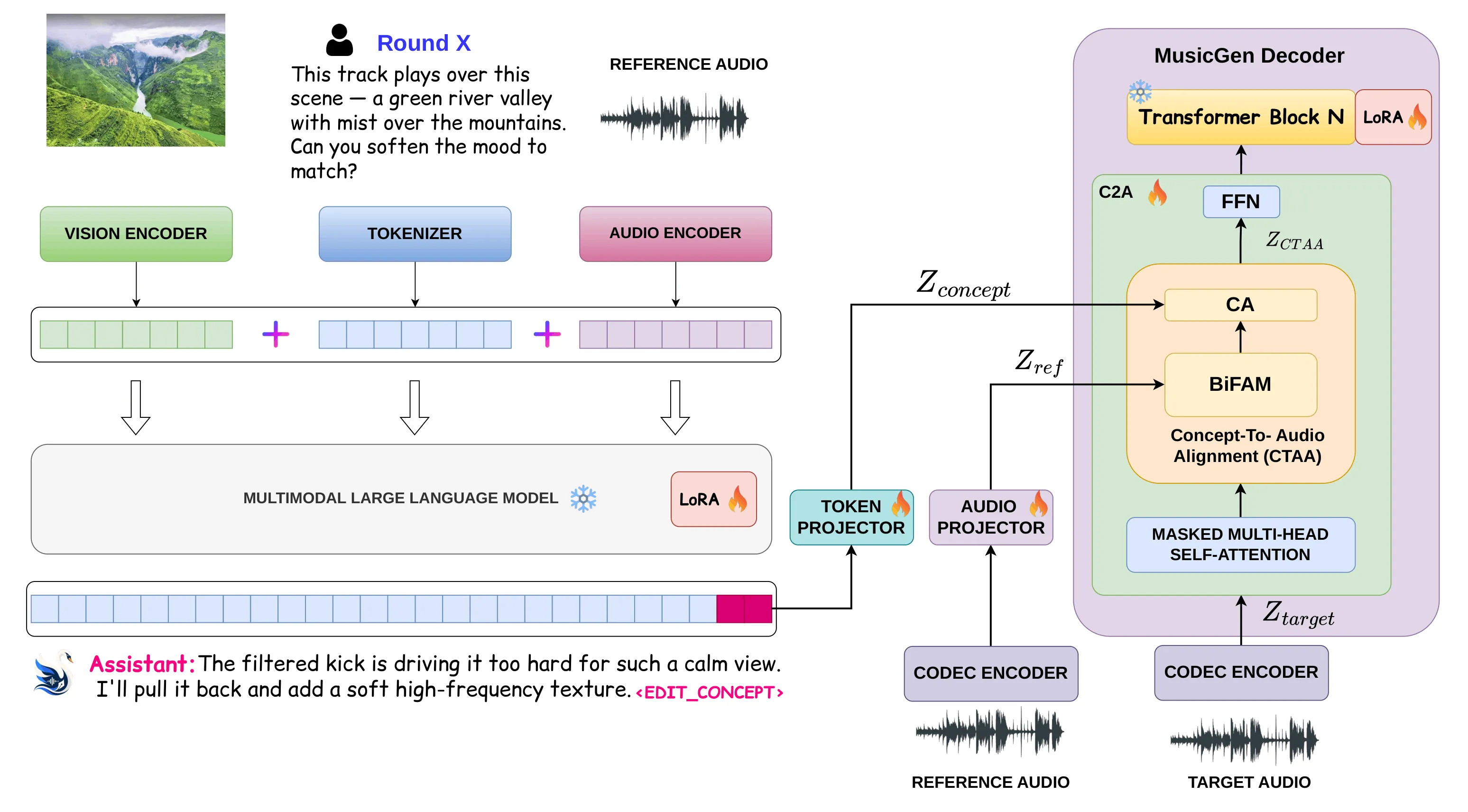
AURA turns music editing into a conversation. A user provides a song and a natural-language request—such as adding an instrument, removing a stem, or changing a mood—and the system replies conversationally before rendering the edited audio.
Most instruction-guided music editors handle each request in isolation. Creative work is usually iterative: people listen, respond, revise, and refine. AURA is designed around that dialogue, using conversation history alongside the audio so an editing session can develop over multiple turns.
The framework combines a multimodal language-model “thinker” with a music generation bridge. The thinker interprets the request and emits typed edit tokens. Those tokens, together with frame-aligned source features, condition a frozen MusicGen backbone through the BiFAM fusion mechanism. Localized edits are anchored to preserve audio outside the requested segment and crossfaded at the boundaries.
The paper evaluates AURA on Slakh2100 and MoisesDB, reporting improvements in edit correctness and preservation over instruction-guided baselines. The public repository includes training, inference, serving, and evaluation code for reproducing the documented workflow.
The code, AURA adapter checkpoints, AURA-Chat-Edit dataset, and arXiv paper are public. The model card reports approximately 2.3 GB of AURA adapters; the Qwen and MusicGen base models are downloaded separately and remain subject to their own terms. A public research demo is also available for exploring the project in the browser.
The AURA interactive demo presents the project as a research demonstration. Review its on-page guidance before uploading or editing audio, and only use material you have permission to use.
Each comparison contains the original input, the held-out reference target, and AURA’s generated edit. The metrics shown are the per-sample values reported by the official demo; FAD is not included because it is a corpus-level metric.
“Music piece. Instruct: Add bass.”
“Remove the bass from the rock mix.”
@misc{trinh2026auraunifiedmultimodalframework,
  title={AURA: Unified Multimodal Framework for Conversational Music Editing},
  author={Quoc-Huy Trinh and Minh-Van Nguyen and Debesh Jha},
  year={2026},
  eprint={2609.14344},
  archivePrefix={arXiv},
  primaryClass={cs.SD},
  url={https://arxiv.org/abs/2609.14344}
}